Manage attestations
Enable attestation participants to step through the attestation process required by your organization.
Attestation enables submitters, reviewers, and approvers to formally certify, review, and sign off on record (model) attributes at specific points in time, supporting compliance and governance processes.
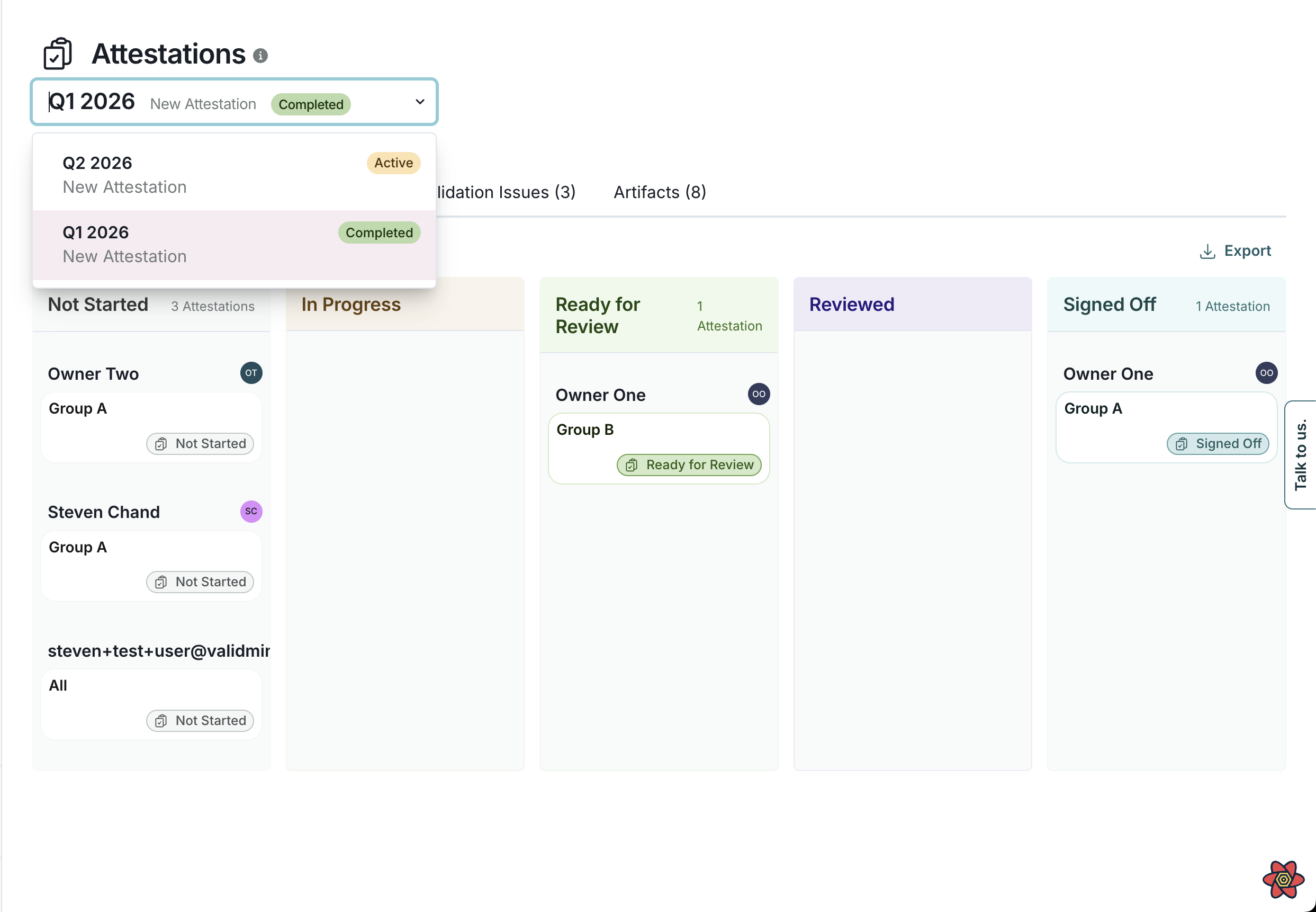
When an attestation period is active or has been completed in the past, Attestations appears in the left sidebar. This centralized dashboard provides:
Attestation participants can also access their individual tasks via My Inbox in the left sidebar, where tasks appear under the Tasks tab with the current attestation status.
Attestation on the ValidMind Platform begins at the start of the attestation period after the process has been set up initially. The platform captures a snapshot of each record and its artifacts, preserving the state at that point in time. A second snapshot is captured when the attestation period is completed, enabling comparative analysis between the start and end states.
Responsibilities for the attestation process are shared:
graph LR
    subgraph Submitter
        A["**Not Started**"] --> B["**In Progress**"]
        B --> C["**Ready for Review**"]
    end

    subgraph Reviewer
        C --> D["**Reviewed**"]
        D -.-> B
    end

    subgraph Approver
        D --> E["**Signed Off**"]
    end
The attestation process — Submitter, reviewer, and approver responsibilities
The submitter is responsible for completing the questionnaire and addressing change requests. The reviewer is responsible for reviewing the questionnaire and requesting any necessary changes. The approver is responsible for signing off on the questionnaire.
Plan your attestation periods ahead of time to ensure they can be completed on time. The start date must be today or a future date, and you cannot set a date in the past to trigger attestation retroactively.
Attestation submissions are organized by owner AND group. This structure supports organizations where:
Attestation questionnaires are typically used in risk management to confirm that key controls, governance processes and documentation requirements have been followed throughout a record’s lifecycle. These questionnaires are part of a broader effort to ensure accountability and regulatory compliance.
Questionnaires are composed of structured fields that you define when configuring the attestation template. Each field can be a text input, dropdown, checkbox, or other field type, with optional validation rules. Responses are collected consistently across all submissions and can be viewed in the consolidated Responses tab or exported for external reporting.
Areas typically covered in the questionnaire:
Verification of responsibilities — Attests that record owners, developers and validators have performed their roles in accordance with internal policies and procedures.
Documentation of compliance — Confirms that required documentation — such as documentation, validation reports and change logs — has been completed and properly archived.
Evidence of control operation — Serves as formal evidence that key controls (for example: backtesting, performance monitoring, version control) are in place and functioning as intended.
Governance checkpoints — Used as checkpoints at critical stages, such as approval, annual reviews or retirement, to ensure all required steps have been completed before proceeding.
Regulatory reporting — In regulated environments, provides a documented trail that can be reviewed during internal audits or by external regulators.
Risk ownership and accountability — By signing off on questionnaires, individuals acknowledge their responsibilities and support a strong control culture.
Work with your risk management team to create a template that accurately reflects your organization’s attestation requirements.